Short answer
Most runners lose between 0.5 and 2.0 litres of sweat per hour, with the full population range spanning roughly 0.3 to over 3.0 L/hr. Dew point matters more than temperature, because sweat only cools you when it evaporates. But the important part is what you do with the number: the evidence supports drinking to thirst rather than replacing every millilitre. Losing up to about 2% of body mass during a run is normal and well tolerated, and overdrinking is the more dangerous error.
In a study of college-age runners completing a one-hour outdoor run in temperate conditions, researchers measured how much fluid the runners actually lost and then asked them to estimate it.
Measured loss: 1,353ml on average. Perceived loss: 686ml.
They guessed almost exactly half. And these were competitive runners — cross-country team members and running club athletes — on a mild day, not a brutal one. The conditions were pleasant enough that most people would not have described the run as especially sweaty.
That gap is the whole problem with hydration advice. Not that runners refuse to drink, but that the quantity is genuinely invisible from the inside. You cannot feel a litre leaving.
What actually sets your sweat rate
The honest headline number, from the ACSM position stand on fluid replacement: most athletes lose between 0.5 and 2.0 litres per hour, with the full population range running from about 0.3 to over 3.0 litres per hour.
That is a tenfold spread, and it is worth sitting with, because it means every generic recommendation you have ever read — drink 500ml an hour, take a bottle every 45 minutes — is a number picked from the middle of a range wide enough to be meaningless at the edges. Two runners side by side on the same road in the same weather can differ by a factor of three.
Four things drive it:
| Factor | Effect on sweat rate |
|---|---|
| Body size | More mass means more heat generated and more surface to cool. The single largest individual difference. |
| Intensity | Heat production scales with work rate. A tempo hour costs substantially more fluid than an easy hour. |
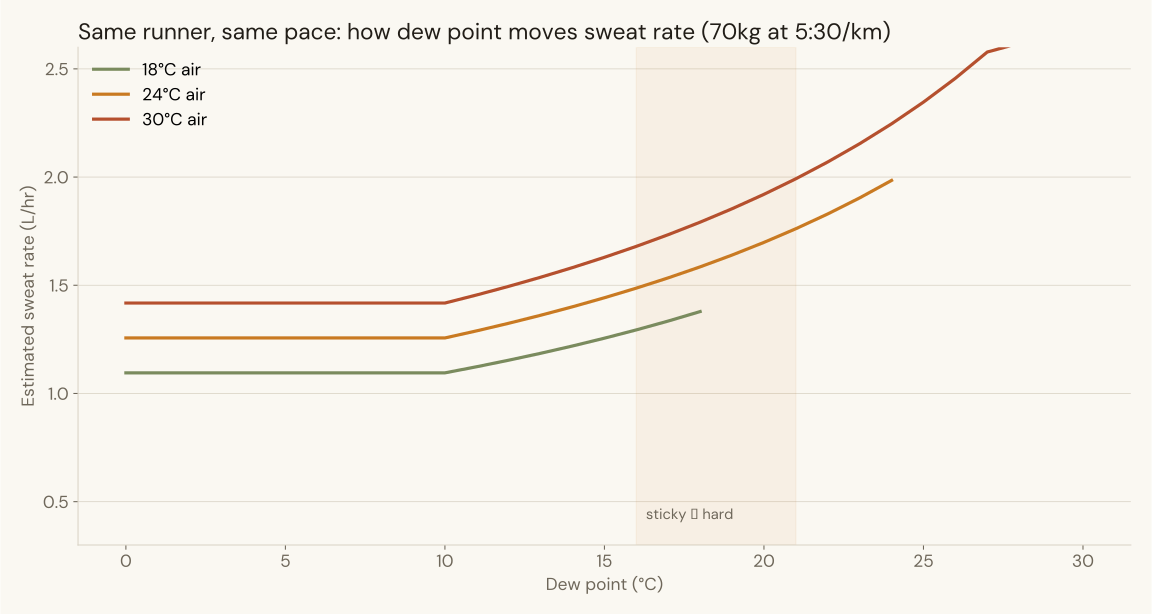
| Dew point | Determines whether sweat can evaporate. High dew point means more sweat produced for less cooling returned. |
| Acclimation | Adapted athletes sweat earlier and more, but with lower sodium concentration. Better cooling, more fluid. |
The acclimation row surprises people. Getting better at heat does not mean sweating less — it usually means sweating sooner and in greater volume, because that is what effective cooling looks like. What improves is the efficiency of the exchange and how much sodium you give away doing it.
Why dew point beats temperature
Sweat only cools you when it evaporates. Sweat that drips off you has cost fluid and returned nothing.
Whether evaporation can happen depends on how much moisture the air is already holding, and the useful measure of that is dew point rather than relative humidity. Relative humidity is a proportion of a capacity that itself moves with temperature, which makes it a poor tool for comparing one day to another. Ninety percent humidity at 10°C is a nice morning; sixty percent at 30°C is punishing.
This produces the counterintuitive result that a warm, dry day can cost you less fluid than a cooler, saturated one. On dry air your sweat evaporates efficiently, cools you properly, and your body needs less of it. On saturated air the sweat keeps coming and keeps failing to do its job, so you produce more of it for less return.
It is the same variable that drives why a hot week reads as lost fitness and why your heart rate climbs on an easy run. One number, three symptoms.
Your hot-day sweat rate can be double your cool-day rate. A single measured number is a starting point, not a fixed property of your body.
The part most advice gets wrong
Here is where a post about fluid loss usually goes badly, so let us be direct: knowing you lost 1.5 litres does not mean you should drink 1.5 litres during the run.
The evidence moved on this and a lot of running advice has not caught up. Drinking beyond thirst is the primary cause of exercise-associated hyponatraemia — blood sodium falling below 135mmol/L — which has killed otherwise healthy runners in marathons. The Third International Consensus Conference on the condition concluded that drinking according to thirst is sufficient to prevent both dehydration and hyponatraemia, and the Wilderness Medical Society guidelines say the same.
Two further points that matter. Sodium supplementation does not protect you if you are overdrinking — sports drinks are hypotonic and will not prevent the problem. And in ultramarathon research, athletes drinking to thirst showed no hyponatraemia and no performance decrement despite body mass losses above 3%.
The number that actually matters
Up to ~2% of body mass lost during exercise is normal and generally tolerated without meaningful performance cost. For a 70kg runner that is about 1.4kg, or roughly 1.4 litres.
That threshold is also where thirst kicks in. Around 2% body mass loss is approximately the point at which plasma osmolality rises enough to trigger the thirst response — which is what makes thirst a reasonable guide rather than a lagging one.
The goal during a run is to stay under that threshold, not to replace every millilitre. Replacement happens across the following 24 hours, with food and normal drinking.
If the run in question is a race-week long run, the fluid maths sits alongside the fuel maths — the carb loading planner covers the other half.
So what is the sweat number actually for? Three things. Knowing whether you are a 0.6L/hr runner or a 1.8L/hr runner tells you how much to carry on a long run and whether a race with aid every 5km is enough for you. It tells you roughly how much to replace afterwards — and replacement is food as much as fluid, since carbohydrate and sodium both come back with meals. And it flags the days where conditions have pushed you somewhere unusual.
Sodium, and what it is actually for
Sweat sodium concentration varies widely between individuals and, unlike sweat rate, it is largely a fixed trait rather than something that shifts day to day. Acclimation lowers it. If you finish long runs with visible salt crust on your face and dark rings on your cap, you are likely at the higher end.
The practical implication is narrower than the supplement industry suggests. Sodium matters for longer efforts — roughly beyond two hours, and particularly in heat — where large absolute losses accumulate. It matters much less for an hour-long run in mild conditions, where a normal diet covers it comfortably. The same logic governs fuel on the run: see how much carbohydrate to take in per hour for the intake side of a long session. And it is not a defence against overdrinking.
How to find your own number
The gold standard is a weigh-in, and it is genuinely accurate.
1. Weigh yourself before the run
Empty your bladder first. Weigh with minimal clothing, or naked, and note what you did so you can repeat it.
2. Run 60–90 minutes, tracking what you drink
A typical session, not a taper week. Note the volume of any fluid consumed.
3. Towel dry and weigh again
Match the clothing state from step one. Sweat left in your kit will read as fluid you still have.
4. Do the arithmetic
Sweat rate (L/hr) = (weight lost in kg + fluid drunk in L) ÷ hours. Roughly, 1kg of body mass equals 1 litre of sweat. Losing 1.0kg while drinking 0.5L over an hour gives a 1.5L/hr rate.
5. Repeat in different weather
This is the step everyone skips, and the one that matters most. A single measurement in one set of conditions tells you very little, because the number moves with the dew point.
That last step is why almost nobody has a usable sweat rate. The protocol is not difficult, it is just tedious enough that most people do it once, in whatever weather happened that day, and then treat one number as permanent — which is precisely the error that makes it useless.
Or start with an estimate: the sweat rate calculator takes your weight, pace and the day’s temperature and humidity and estimates your rate with no weigh-in at all — and if you have done the weigh-in, enter it to replace the estimate with your measured number and see how far your body sits from the model.
An estimate from session data and conditions will never match a careful weigh-in for accuracy. But it does not need to. It needs to beat the thing you are actually doing, which for most runners is nothing at all, or a single figure measured on one morning eighteen months ago.
Kovr estimates what a session cost you in fluid, and it moves with the weather you actually ran in.
No weigh-in, no spreadsheet. Kovr takes the duration and intensity of the workout from Apple Health, pulls the real temperature and dew point for when you ran, and gives you an estimate of fluid lost for that specific session — so a humid Thursday and a dry Sunday stop returning the same answer. It logs what you drink alongside it, and keeps the framing where the evidence puts it: replace across the day, drink to thirst on the run.
Download Kovr on the App StoreFree with a 14-day trial · Garmin, Apple Watch & Oura
This article is general information about exercise physiology, not medical advice. If you have a heart, kidney or blood pressure condition, or take medication affecting fluid balance, talk to your doctor before changing how you hydrate around training.
Sources cited
- Sawka, M.N., Burke, L.M., Eichner, E.R., Maughan, R.J., Montain, S.J. & Stachenfeld, N.S. (2007). American College of Sports Medicine Position Stand: Exercise and Fluid Replacement. Medicine & Science in Sports & Exercise, 39(2), 377–390.
- O’Neal, E.K., Caufield, C.R., Lowe, J.B., Stevenson, M.C., Davis, B.A. & Thigpen, L.K. (2014). 24-h Fluid Kinetics and Perception of Sweat Losses Following a 1-h Run in a Temperate Environment. Nutrients, 6(1), 37–49.
- Hew-Butler, T. et al. (2015). Statement of the Third International Exercise-Associated Hyponatremia Consensus Development Conference. Clinical Journal of Sport Medicine, 25(4), 303–320.
- Bennett, B.L. et al. (2020). Wilderness Medical Society Clinical Practice Guidelines for the Management of Exercise-Associated Hyponatremia. Wilderness & Environmental Medicine.
- Hoffman, M.D. & Stuempfle, K.J. (2014). Hydration strategies, weight change and performance in a 161 km ultramarathon. Research in Sports Medicine, 22(3), 213–225.
Frequently asked questions
How much fluid do you lose per hour running?
Most athletes lose between 0.5 and 2.0 litres per hour, with the full population range running from roughly 0.3 to over 3.0 litres per hour. In one study, trained runners lost an average of 1,353ml during a one-hour run in temperate conditions — while estimating their own loss at 686ml, roughly half the true figure.
Should I drink to replace all the fluid I lose?
No. Drinking beyond thirst is the primary cause of exercise-associated hyponatraemia, which has killed otherwise healthy runners. The Third International Consensus Conference concluded that drinking according to thirst is sufficient to prevent both dehydration and hyponatraemia. Losing up to about 2% of body mass during a run is normal and generally well tolerated.
What is a normal sweat rate for a runner?
There is no single normal. Body size, intensity, dew point and heat acclimation all move it, and two runners side by side in identical conditions can differ threefold. The useful figure is your own, measured in more than one set of conditions, since your hot-day rate can be double your cool-day rate.
Why does dew point affect how much I sweat?
Sweat cools you only when it evaporates. Dew point measures how much moisture the air already holds, so a high dew point means sweat keeps being produced without delivering cooling. A warm dry day can therefore cost you less fluid than a cooler saturated one, because dry air lets each drop do its job.
How do I measure my sweat rate?
Weigh yourself before a run with an empty bladder, run 60–90 minutes noting any fluid consumed, towel dry and weigh again in the same clothing state. Sweat rate in litres per hour equals weight lost in kilograms plus fluid drunk in litres, divided by hours. Repeat in different weather, because a single measurement in one set of conditions is not representative.
Do I need electrolytes or salt tablets when running?
For runs beyond roughly two hours, especially in heat, sodium replacement is worth considering because absolute losses accumulate. For an hour in mild conditions a normal diet covers it. Importantly, sodium does not protect against overdrinking — sports drinks are hypotonic and will not prevent hyponatraemia if you are drinking beyond thirst.